



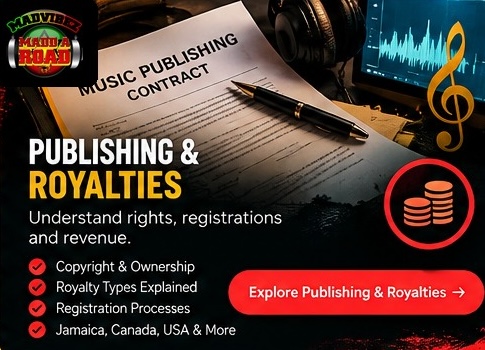
Publishing & Royalties: a practical guide for independent artists
Know what you own, understand how music earns royalties, and find legitimate organizations to help collect the money associated with your songs and recordings.
One recording can involve two separate copyrights
Recording and releasing a track is not the same as registering all the rights connected to it. Understanding this distinction is the foundation of royalty collection.
1. The composition (the song)
Protects original musical and lyrical authorship. Songwriters, composers and music publishers may receive income from performing and reproduction rights, depending on the use and agreements.
Example: the person who writes a chorus or composes the rhythm may hold a share of the composition.
2. The sound recording (the master)
Protects a specific recorded performance. Recording owners, labels and performers may have separate royalty entitlements depending on contracts, uses and local law.
Example: a label may own a master while the singer and producer retain agreed songwriting shares.
Where music royalties can come from
Public performance
When a composition is used in eligible broadcasts, concerts, venues and certain online services. Collection societies often administer these rights.
Mechanical / reproduction
Related to reproductions of a composition, including eligible streams, downloads and physical products; local rights and administration differ.
Master recording revenue
Revenue from licensed use of the recorded track, including distributor-reported uses on digital services, subject to ownership and agreements.
Neighbouring / digital performance
Certain uses of recordings can create payments for performers and recording rights owners. Rules differ by country and type of service.
Synchronization licensing
Placing music in film, TV, advertising or games commonly requires authorization for both the composition and the master recording. Fees depend on negotiated terms.
Other licensing
Samples, remixes, riddim use and dubplates can require negotiated permission. A dubplate fee is not automatically a substitute for clearing copyrighted material.
Important: A digital distributor does not necessarily register compositions with royalty collection organizations, and joining a songwriter society does not automatically collect every master-recording royalty.
Your royalty collection action plan
- List every track: record title, artist name, legal songwriter names, producer, release date and territories.
- Agree on ownership shares: make written split sheets and document any publisher, label, producer or administrator agreements before distribution.
- Distinguish rights: confirm who owns the musical work and who owns the master recording; do not assume they are the same person.
- Check your existing affiliations: review your performing-rights society, publisher and administrator before registering elsewhere. Duplicate claims may delay payment.
- Register works and verify metadata: supply accurate titles, writer names, shares and identifiers such as ISRC (recording) and ISWC (work, where assigned).
- Review recording royalties: check with your distributor, label, relevant performers’ or recording-rights organization and, when relevant, SoundExchange.
- Track usage and statements: keep set lists, broadcast information, royalty statements and release records; reconcile unexplained missing income with the appropriate organization.
Royalty and rights organizations
These organizations perform different functions. Registration eligibility, representation territory and rights mandates vary. Check their official instructions before applying.
Jamaica
Collective management and licensing for eligible composers, authors and publishers in Jamaica; offers international reciprocal relationships.
Official website → Membership guidance →Confirm fees directly: the official membership page and FAQ show different fee figures.
Canada
Administers eligible performance and reproduction rights for music creators and rightsholders, including international collections through agreements.
Official website →Canadian collective for eligible neighbouring-rights royalties from the public use of sound recordings.
Official website →United States — compositions
U.S. performance-rights organization for affiliated songwriters, composers and publishers.
Official website →U.S. performance-rights organization for affiliated writers, composers and publishers.
Official website →Administers U.S. blanket-license digital mechanical royalties for eligible compositions. Overseas authors may already be represented by their publisher or society.
Official website →United States — sound recordings
Collects and distributes certain U.S. non-interactive digital performance royalties for featured artists and sound-recording copyright owners.
Official website →SoundExchange and ASCAP/BMI do not administer the same category of royalties.
Important scenarios for reggae and dancehall professionals
Riddims with multiple vocalists
Document the underlying musical composition and the authorship of each song version. A producer credit alone does not establish every ownership share.
Dubplates and sound-system specials
Confirm the recording permission, writers’ and publishers’ permissions where required, allowed uses and whether the payment is for a recording service, license or both.
Remixes and sampling
Sample clearance may require permission from the sound-recording owner and the composition owner. Attribution alone does not replace licensing.
Jamaica-to-Canada collaborations
Use consistent legal names and written splits, and determine who administers each territory. Do not register competing claims for the same shares.
Frequently asked questions
No. Distribution covers specific sound-recording exploitation and agreements. Composition, performance, mechanical and neighbouring-rights collections can require other registrations or representation.
Not automatically. A writer may already be represented internationally through an existing society and its reciprocal arrangements. Check affiliations before joining or registering elsewhere.
You may have interests in both the composition and recording, but must check who owns each right and what your contracts say.
Writer names and agreed percentages, master ownership, producer agreements, distributor identifiers, release dates and royalty statements.
Build on the foundation
Use this guide to prepare your music-rights records, then consult the relevant society or a qualified music-rights professional for questions specific to your agreements or country.
Prepared for general music-industry education by Madd A Road Media. Not legal, financial or tax advice. Official websites and eligibility may change. Last research review: October 20, 2026.